
Getting Around: From "Huge Problem" to "Mostly Solved" in a Decade
Some good news about tech, aging, AI, and robots.
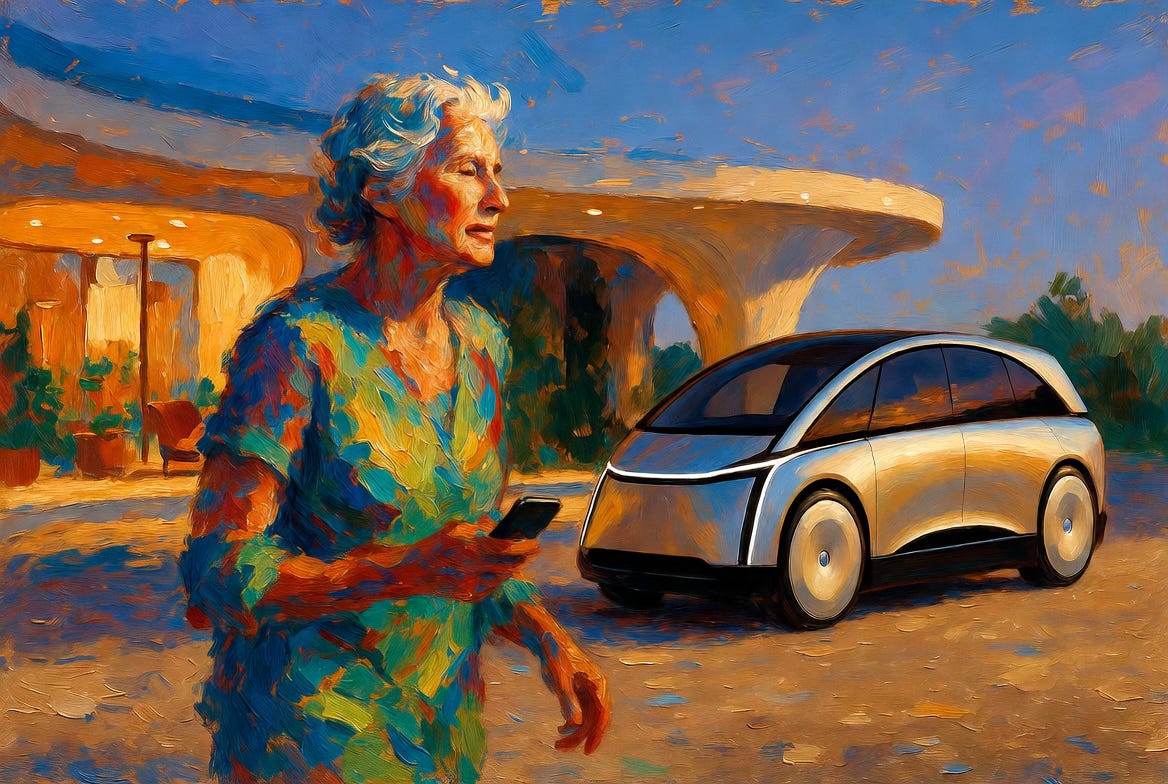
We often express disappointment about how the same, aging-related challenges remain unaddressed, despite all the enthusiasm for agetech and new companies in the aging space.
But, there is one thing that was a huge issue in Longevity Explorer discussions a decade ago, and which has now largely been solved. That’s exciting and deserves writing about!
The issues: “How to Get Around?”, and “What happens when you can’t drive anymore?”
Back in 2016:
Getting Around, Taking the Car Keys, Uber
Back in 2016, hundreds of Longevity Explorers participated in a series of rolling discussions about the things they saw as the most pressing “issues” relating to their everyday lives.
A big recurring theme was the challenge of Getting Around, once you could no longer just hop in your car and drive somewhere any time you wished.
Related topics were How would you know when it was time to stop driving?, and Who would decide you should no longer be driving?
See these explorations for what we discussed back in 2016:
At the time, Uber and Lyft were starting to become popular, and the explorers started learning about, and trying out, the ride sharing services.
It was already clear then that ride sharing would have a big impact on quality of life for older adults. As one explorer said “This has changed my life. Instead of waiting for the social services person to be available to take me on the aged care bus, which only stops at certain places, now I can summon a car whenever I want and go wherever I want”.
“This has changed my life. Instead of waiting for the social services person to be available to take me on the aged care bus, which only stops at certain places, now I can summon a car whenever I want and go wherever I want”.
Preparing for the Day
Here is explorer Mavis’ story:
“I love going out to the cinema, and to concerts, theatre, and to meet with my friends. I have always had a very active social life.
In my 80’s, I would drive myself everywhere, at night or during the day, and never thought twice about it.
But my daughter encouraged me to start using Uber sometimes. At first it was a bit daunting using the app. But after a while I got used to it. It still was not as good as driving myself, but I started using it more and more, at times when parking or the dark were off-putting.
Now, I am 94. A few years ago, my daughter told me I really needed to stop driving. And, I had a few falls. And now I live in a very pleasant aged care facility.
BUT, I still love going to see my friends, and going to movies and the theatre and concerts.
And I still do all that. I just walk outside my building (with my walker) and call an Uber. It takes me to wherever I am going, and then when I am finished I call another one to get me and take me home.
It means that even though I am no longer a spring chicken, I can still do pretty much whatever I want.”
Like Mavis, after exploring ride sharing, the more savvy explorers took the following approach.
Step 1: They got familiar with Uber and Lyft, and started using them “every now and then”, even though they did not yet need to.
Step 2: They started relying more and more on these services. For example, when they went out at night. Or when they felt a bit tired and did not want to drive.
Step 3: One day it became clear that they should no longer be driving. Maybe they had a fall or accident. Maybe their vision declined beyond a point. Or their cognition. Or maybe their daughter said “Mum, … its really time to stop driving”.
Step 4: They stopped driving themselves around, but just switched completely to using the Uber or Lyft services. Instead of becoming dependent on the kindness of strangers, they were still in control of their lives.
Not Perfect
Of course, this is not perfect for everyone.
Some explorers commented that they live in the country, and there is no Uber or Lyft there. Some commented that there were costs involved.
Other explorers pushed back and said: “Ride sharing might actually be cheaper than maintaining and running and insuring your own car”. And “Where you live as you get older is a big decision. Getting around should be part of that decision”.
Other explorers pushed back and said: “Ride sharing might actually be cheaper than maintaining and running and insuring your own car”. And “Where you live as you get older is a big decision. Getting around should be part of that decision”.
Since 2016, things have been changing further, and now in 2026 we seem on the cusp of the next step-change in getting around.
In 2026
The future of Getting Around can already be seen in places like San Francisco, although it has not yet spread “everywhere”.
Here are some vignettes of how individual explorers approach getting around today, and how we think many more older adults will live soon.
Uber + Waymo
For those of us in the “step 1” stage of the progression above (in San Francisco), you now have a choice. You can use Uber, the same as before. Or now you can, as an alternative, summon a self driving car (eg Waymo) whenever you wish.
Is this “better” than Uber? Maybe. It is certainly amazing to be able to be driven around by a car with no person in it, other than you.
Some people like the safety aspects of not having to worry about who the driver is.
Some people think the self driving is safer than many “people” drivers.
And maybe in the long term it will be cheaper (that day is not yet here).
It certainly seems just a question of time before this self driving technology expands to many parts of the country and globe.
One detail that is worth mentioning. What if you need assistance? For example, explorer Mavis (above) has a walker, and is a bit frail, although mentally very sharp. She relies on the Uber driver to put her walker in the back of the car and help her in.
That is something a self driving car cannot yet do.
Says Explorer Roger:
“I am 70, and live with my wife and adult daughter. We like to go out for pizza each Sunday night.
I always used to drive. Then when my daughter got her license, she loved to drive us. And sometimes one or other of us still drives to dinner.
But, increasingly, we think about the annoyance of finding a parking place, the fact you can’t have a drink if you want to drive home, and the pleasure of just sitting back and letting someone else drive. So, more and more we use a self driving car (Waymo) service.
We used to use Uber every now and then. For at least the last year we almost never use Uber, but instead use Waymo (no person other than us in the car). We think it is a better driver than most Uber drivers we get. And maybe better than us now.
As I get older, the idea of not worrying about driving myself at night gets more and more desirable.”
Your own self driving car
But what if Waymo is not yet in your part of the world and is not about to be? Or what if you want to be able to go on long trips that are prohibitive with ride sharing services?
Meet explorer John:
“I live in a lovely suburb. I don’t want to move. But at almost 80, I worry about getting around in the future.
Here is my plan.
I bought myself a Tesla several years back. Whenever I go anywhere I use the (supervised) self driving.
I see it as training me to get used to the idea that the car is in control, although at present I am still supervising it.
It just keeps getting better, although it is still not perfect.
In the last two years I have used it to go on two cross country trips with my wife. The car did almost all the driving (with us supervising). It was amazing.
I fully expect that “soon” the technology will be good enough so we no longer need to supervise it. And when I can no longer drive, I will be so used to using the self driving, I will barely notice.
Instead of being an existential crisis, taking away my car keys will barely matter to me at all.”
Instead of being an existential crisis, taking away my car keys will barely matter to me at all.
The important aspect of this approach, is that you can live anywhere. So for those who worry that Uber or Waymo will never come to their geography, this takes care of that problem.
Still expensive
This approach is definitely still expensive. But what price autonomy?
And over time, it seems likely this will move fairly quickly into the range of affordable for most.
What Comes Next?
The path forward for Getting Around seems fairly clear from these anecdotes. It’s just not universally distributed as yet.
But what does this suggest for other issues faced by older adults?
We are starting to get hopeful about robots at home for doing chores like taking out the garbage, doing the washing and the washing up, and similar tasks.
Are these things here as yet? Definitely not.
Will we look back on this post the way we are now looking back on our 2016 exploration and say “Wow. These other things are now solved too?”
Time will tell. Let’s hope so.
Disclaimer
We do NOT benefit financially in any way from the products or companies discussed in this post.
"Some people think the self driving is safer than many “people” drivers."
Over the years Waymo has logged nearly 70 million miles and the data if irrefutable, it's much safer than human drivers. This shouldn't be a surprise, planes have flown "by wire" for decades.
So many former drivers are unable to continue driving due to cognitive deficits. The new learning required to master ride apps is a barrier. Get.gogograndparent.com skirts that issue by using a phone call to order a ride. They offer 24/7 customer service and operators. No smart phone needed. They work in conjunction with Uber and Lyft